Build something you care about and benefits others
Zena Hitz on great books.
Read the note →
Zena Hitz on great books.
Read the note → We no long even pretend with the pretense of fairness.
Read the note →Big spike in abandoned oil tankers.
Read the note →Pranay Kotasthane as usual with a thoughtful take on the state of affairs:
Lastly, the general impression I take away from this budget is the realisation of a party in power which has figured out a way to win elections in India that’s not contingent on strong economic performance. So long as you don’t screw up the economy badly, a combination of emotional issues and timely welfarism (direct cash transfer just before elections is a new, powerful tool now) should see you through most elections. Therefore, a 6.5 per cent growth and a 4 per cent fiscal deficit in a world that’s volatile and unpredictable is good enough to keep the global investors mildly interested while keeping the winning machine going domestically. That may not be enough for us to get out of the middle-income trap or lose out on the narrow window of demographic dividend we had. But the willingness to take bolder bets to address such structural challenges seems to have dissipated. More of the same is what we have settled for.
In praise of solitude.
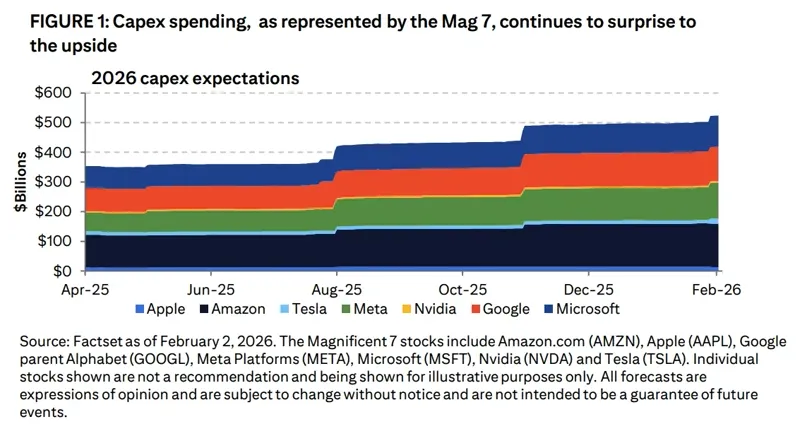
Read the note →These big tech capex numbers are ridiculous
Big Tech companies will have to raise tens of billions of dollars to fund their skyrocketing investments in artificial intelligence this year, as capital spending outpaces cash flows even among some of the world’s most profitable companies.
Google’s parent Alphabet, Amazon and Meta all surprised investors with the scale of their AI spending plans over the past two weeks. A total of more than $660bn is set to be ploughed into chips and data centres this year as they race to dominate what many in Silicon Valley believe will be the biggest wave of innovation since the internet.
The unprecedented infrastructure build-out will force Big Tech executives to choose between stemming capital returns to shareholders, raiding their cash reserves or tapping the bond and equity markets more than previously planned, analysts say.
For the experiment, the authors — representing a diversity of mathematical fields — each contributed one test question that arose from research they had in the works but had not yet published. They also determined the answers; these solutions are encrypted online and will be released on Feb. 13.
“The goal here is to understand the limits — how far can A.I. go beyond its training data and the existing solutions it finds online?” said Dr. Kolda, who is one of few mathematicians to be elected a member of the National Academy of Engineering.
The team conducted preliminary tests on OpenAI’s ChatGPT-5.2 Pro and Google’s Gemini 3.0 Deep Think. When given one shot to produce the answer, the authors wrote, “the best publicly available A.I. systems struggle to answer many of our problems.”
François Chollet on the money here:
Whenever I hear Very Serious Businessmen make confident pronouncements about the future of AI, I remember what the very same people were saying in 2021 about the Metaverse and NFTs.
When you lack a grounded, causal model of the world, your “predictions” are simply a remix of narratives you’ve heard from others.
Reminds me of something, actually
Good time to remember Bhuvan’s law:
“Any discourse about artificial intelligence is indistinguishable from talking out of your ass.”
I wrote about all the side projects I’ve been building with the help of AI coding tools like Claude Code and Codex.
Stupidity is Lindy.
Read the note →A small corner on the internet to discover wonderful writing.
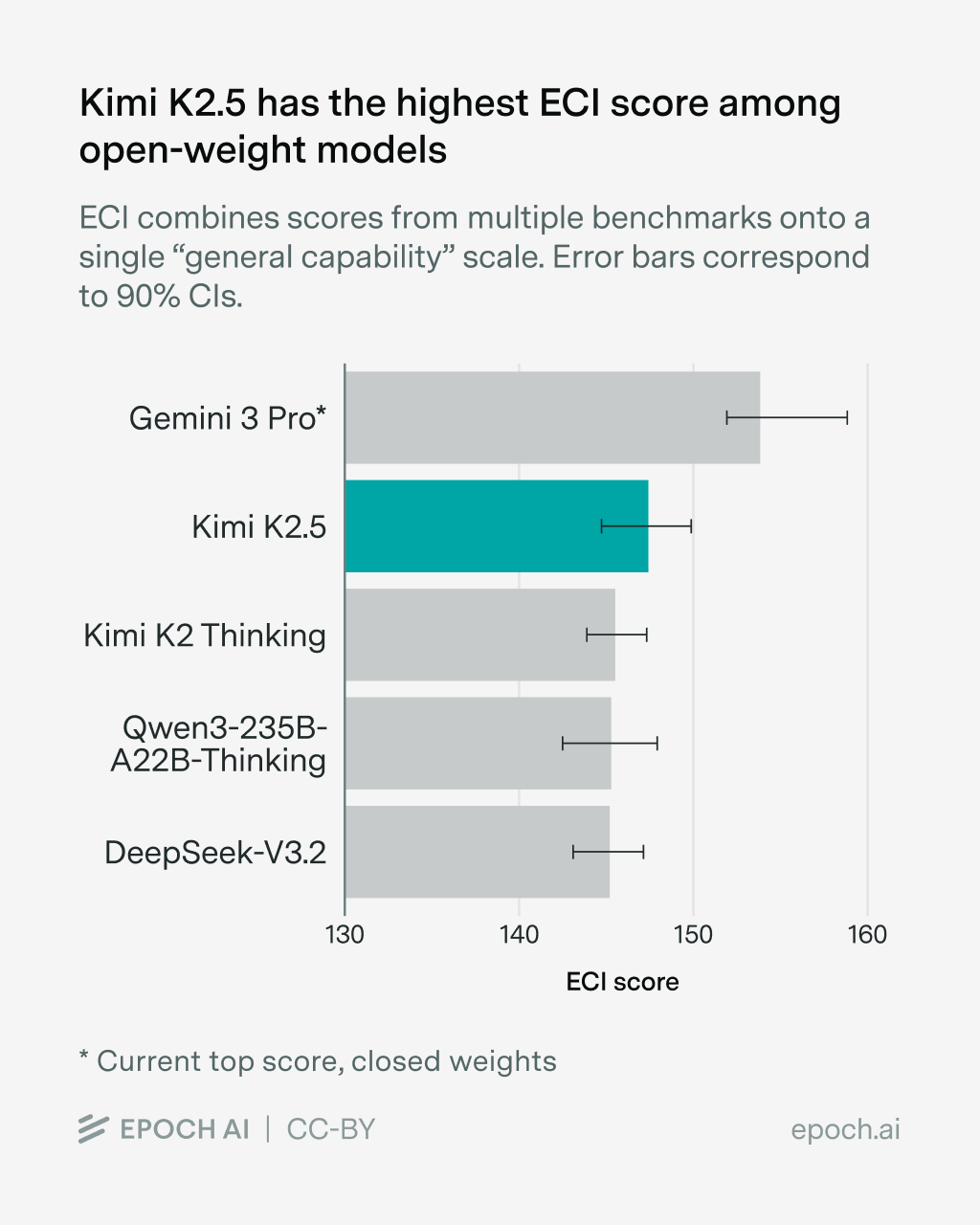
Read the note →It’s crazy how good good open source LLMs have gotten.
Kimi K2.5 set a new record among open-weight models on the Epoch Capabilities Index (ECI), which combines multiple benchmarks onto a single scale. Its score of 147 is about on par with o3, Grok 4, and Sonnet 4.5. It still lags the overall frontier.
Wow
“I was always a little bored by demonstrations of evil.
They relied on the same things. I used to say it always has this top hat and a cape and a tuxedo and a cane. And it has all this stuff. Glamour and costume. Maybe even a little theme music. But goodness never has anything, ‘cause it doesn’t want anything. It can’t use anything. It’s just there.”
~ Toni Morrison (2013)
YouTube · youtu.be ↗Toni Morrison on the Concept of Good and EvilThe 92nd Street Y, New York on YouTube
H/t Angus Hervey
Human psychology is eminently hackable.
Read the note →
The momentum effect is real.
Read the note →💯 We are headed for an age of anxiety, grievances, and disillusionment, and I don’t think our systems, as they are designed, are equipped to handle the tsunami of angst:
THERE is still time for the cheerful and the gloomy to disagree, sincerely, about the net impact on employment from automation and artificial intelligence. Perhaps AI will unleash a job-creating economic boom for the ages, as boosters maintain. Maybe on balance the doom-mongers are right, and grim legions of algorithm-guided bots and robots will conquer one industry (and profession) after another.
One outcome is not up for debate. Across the industrialised world, wise politicians are braced for soaring public anxiety about change. Whether AI’s long-run effects are benign or cruel, many citizens are about to find once-valued skills and credentials surplus to the requirements of the economy. Even as new jobs are created, some flesh-and-blood workers may lack autonomy, or indeed dignity, if they feel they are serving AI masters.
John herrman on Dario Amodei’s recent essay.
Read the note →Good perspective on how AI is changing the nature of work on different types of organizations.
Read the note →Salvatore Sanfilippo on the distinction between vibe coding and “automatic programming”:
I’m a programmer, and I use automatic programming. The code I generate in this way is mine. My code, my output, my production. I, and you, can be proud.
If you are not completely convinced, think to Redis. In Redis there is not much technical novelty, especially at its start it was just a sum of basic data structures and networking code that every competent system programmer could write. So, why it became a very useful piece of software? Because of the ideas and visions it contained.
Programming is now automatic, vision is not (yet).
Finland is considering banning social media access for children under 15.
The concerns over social media, and in particular the effects on children, have been well-documented — but Finnish researcher Silja Kosola’s recent description of the phenomenon as an “uncontrolled human experiment” has grabbed people’s attention once again.
Kosola, an associate professor in adolescent medicine, has researched the impact of social media on young people, and tells Yle News that the consequences are not very well understood.
“We see a rise in self-harm and especially eating disorders. We see a big separation in the values of young girls and boys, which is also a big problem in society,” Kosola explains.
From Olga Tokarczuk’s Nobel biography: I was an untroublesome child who looked after herself. For a short time I went to the village kindergarten, but I didn’t feel too good there. My strongest memory of the place is of being made to have a lie-down in the middle of the day and of sitting in a tree when I didn’t want…
Read the note →A good post on what does it mean to translate a literary work.
Read the note →New age shitty bribes.
Read the note →Goodman writes:
Not speaking and speaking are both human ways of being in the world, and there are kinds and grades of each. There is the dumb silence of slumber or apathy; the sober silence that goes with a solemn animal face; the fertile silence of awareness, pasturing the soul, whence emerge new thoughts; the alive silence of alert perception, ready to say, “This… this…”; the musical silence that accompanies absorbed activity; the silence of listening to another speak, catching the drift and helping him be clear; the noisy silence of resentment and self-recrimination, loud and subvocal speech but sullen to say it; baffled silence; the silence of peaceful accord with other persons or communion with the cosmos.
Christopher Ricks reads Paul Goodman on silence https://on.soundcloud.com/UI7DiBnWBSJd2FdFnN
Some weird, wonderful, and depressing facts.
Read the note →The insatiable hunger of AI companies for structured data is ruining things for others:
As news publishers try to safeguard their contents from AI companies, the Internet Archive is also getting caught in the crosshairs. The Financial Times, for example, blocks any bot that tries to scrape its paywalled content, including bots from OpenAI, Anthropic, Perplexity, and the Internet Archive. The majority of FT stories are paywalled, according to director of global public policy and platform strategy Matt Rogerson. As a result, usually only unpaywalled FT stories appear in the Wayback Machine because those are meant to be available to the wider public anyway.
“Common Crawl and Internet Archive are widely considered to be the ‘good guys’ and are used by ‘the bad guys’ like OpenAI,” said Michael Nelson, a computer scientist and professor at Old Dominion University. “In everyone’s aversion to not be controlled by LLMs, I think the good guys are collateral damage.”
Yes markets make people more outward looking, trusting, and tolerant, but:
All this sounds pretty good for the Montesquieus of the world. But the researchers had another result. Greater market access did seem to weaken family-based co-operation, lowering the share of vulnerable people including orphans, people with disabilities and the elderly being looked after by relatives at home.
So if you were looking for a simple answer, sorry. The study supports both sides’ view of markets — they make it easier to co-operate with strangers but potentially weaken ties closer to home. Think of the Marmite not as delicious nor disgusting, but as a complex mix of flavours reorienting your taste buds.
I don’t know if this is true:
A Ukrainian AI-powered ground combat vehicle near Lyman refused to abandon its forward defensive position and continued engaging enemy forces, despite receiving multiple orders to return to its company in order to preserve its hardware.
The UGV reportedly neutralized more than 30 Russian soldiers before it was ultimately destroyed.
While the Russian detachment was pinned down, Ukrainian infantry exploited the opportunity and cleared two contested fields of enemy presence, successfully re-establishing control over the area.
These events took place during the final week of December 2025.
h/t Zvi Mowshowitz
Bang on! The lesson to take from Nietzsche is that we all may not fully understand the implications of our most cherished values, our personal beliefs, or actions, and live our entire lives in ignorance or self-denial, unconsciously undermining ourselves and others. How do we avoid this? We need to make sure that the…
Read the note →What will the post-AI future look like? Here are four scenarios outlined by Allison Schrager:
AI can ruin your Hinge date. It can detect cosmic anomalies. It can make history come alive. But it cannot suspend the basic laws of economics, says Allison Schrager. Elon Musk’s recent prediction — that AI will make saving for retirement unnecessary — is complete hogwash in her eyes. Consider the following four scenarios. In the future, Allison says AI will either …
1.Make us more productive in the same way that railroads, the telegraph and electricity did in the past.
2.Transform our lives in a completely novel way by speeding up and possibly even spurring innovation.
3.Become a useful tool that won’t boost productivity very much right away, but will disrupt society like the internet.
4.Kill us all.
OK, fine. I guess if No. 4 happens, you won’t be needing a 401(k). But Allison, who is bullish on the future of AI, says such apocalyptic forecasts are highly unlikely.