Bhuvan.Essays, notes and small websites
Notes · 474Page 10 of 16

Short things, kept in the open. A commonplace book, formerly rabbitholes.garden.

Links worth your time with a line on why, quotes, verse, half-thoughts and the occasional rant. Longer pieces live in writing. Follow along by RSS.

Note

Feel the AGI!

Andrej Karpathy on coding with AI assistants: Given the latest lift in LLM coding capability, like many others I rapidly went from about 80% manual+autocomplete coding and 20% agents in November to 80% agent coding and 20% edits+touchups in December. i.e. I really am mostly programming in English now, a bit sheepishly…

Read the note →
x.com ↗
Note

What factors enabled China to dominate so many critical industries?

I was reading this article by Kyle Chan on the great reversal in technological dominance. Until recently, the West was the undisputed leader across “all” technologies, but now the tables have turned. China is now the top dog across a whole range of industries from EVs, solar, AI, robotics to pharma that Western…

Read the note →
Rabbit Holes · rabbitholes.garden ↗ChinaA public commonplace book: links, quotes, poems and stray thoughts, kept in the open.
rabbitholes.garden ↗
Note

Electric vehicles are reducing pollution

Electric vehicles are reducing pollution:

For the analysis, the researchers divided California into 1,692 neighborhoods, using a geographic unit similar to zip codes. They obtained publicly available data from the state’s Department of Motor Vehicles on the number of ZEVs registered in each neighborhood. ZEVs include full-battery electric cars, plug-in hybrids and fuel-cell cars, but not heavier duty vehicles like delivery trucks and semi trucks.

Next, the research team obtained data from the Tropospheric Monitoring Instrument (TROPOMI), a high-resolution satellite sensor that provides daily, global measurements of NO₂ and other pollutants. They used this data to calculate annual average NO₂ levels in each California neighborhood from 2019 to 2023.

Over the study period, a typical neighborhood gained 272 ZEVs, with most neighborhoods adding between 18 and 839. For every 200 new ZEVs registered, NO₂ levels dropped 1.1%, a measurable improvement in air quality.

“These findings show that cleaner air isn’t just a theory—it’s already happening in communities across California,” Eckel said.
keck.usc.edu ↗
Link

The coming of the robots is delayed

The robots aren’t going replace humans anytime soon. Or that’s what one hopes.

Michael Tam, chief brand officer at Shenzhen-based UBTech, which has partnerships with carmaker BYD and Apple contractor Foxconn, said its Walker S2 robots were 30 to 50 per cent as productive as humans and only in certain tasks such as stacking boxes and quality control.

Yet manufacturers are still racing to order them to avoid losing out to competitors, Tam told the FT. “You can imagine … if Tesla has the advantage of deploying their own human robots into the manufacturing line, that means maybe BYD, they are staying behind.”

ft.com ↗
Note

A short intro to Baruch Spinoza’s philosophy

I asked Claude to write me an essay about Baruch Spinoza, his philosophy, big ideas and impact: Baruch Spinoza: The Philosopher Who Saw God in Everything Baruch Spinoza stands as one of the most radical and influential philosophers in Western history, yet his ideas remain surprisingly relevant to modern concerns about…

Read the note →
Link

Dare to feel

Beautiful: Cummings should know — just four years earlier, he had fought that hardest battle himself: When he was awarded the prestigious Academy of American Poets annual fellowship — the MacArthur of poetry — Cummings had to withstand harsh criticism from traditionalists who besieged him with hate for the bravery of…

Read the note →
themarginalian.org ↗
Link

Flimsy beliefs

Brilliant post by Andy Masley as usual: I’ve been in a lot of conversations with people who are seemingly structuring their whole lives around a belief, but when I poke them and ask them simple obvious questions they act like they’ve never thought about it before. This happened a lot in education and pedagogy, a field…

Read the note →
andymasley.substack.com ↗
Note

The fault in our precious metals

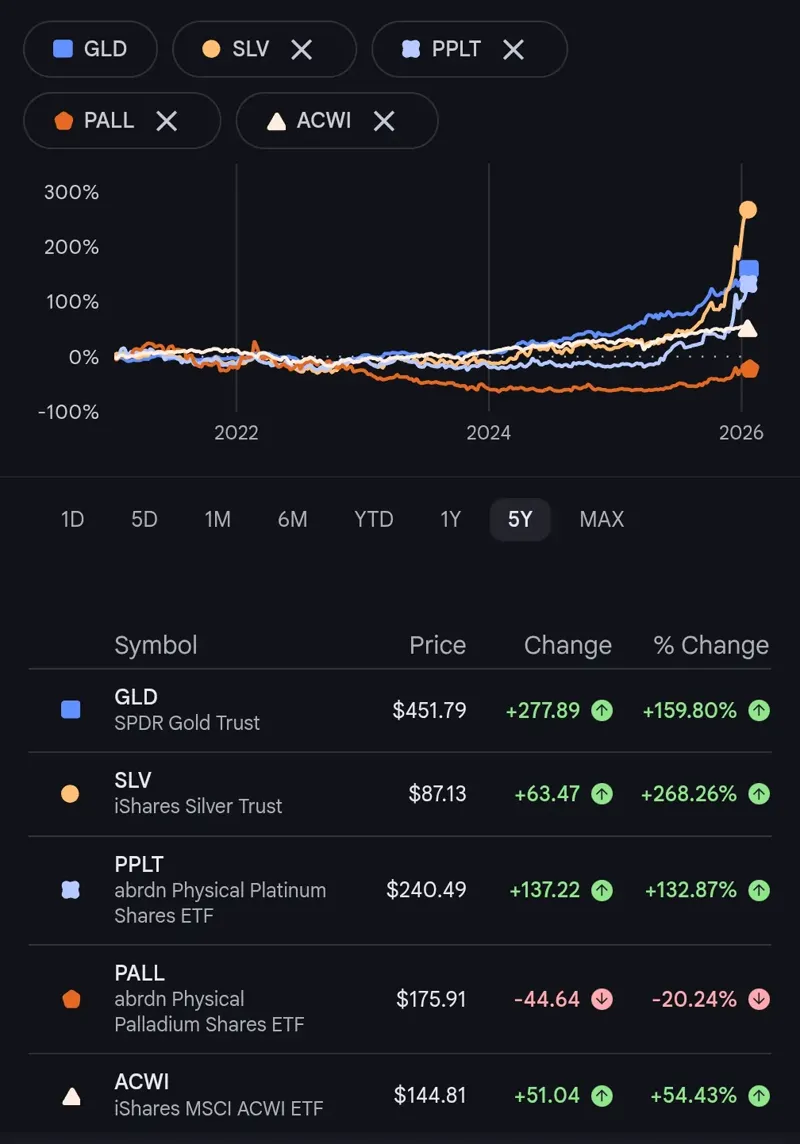
The way precious metals like gold, silver, palladium etc are trading is unreal. I have small gold and silver positions and the I haven’t seen things move the way they have in the last 3-4 since COVID. performance of precious metals Robin Brooks thinks precious metals are rising because of fears of debasement.

Note

O ye of little hope

Will Manidis on target once again. I’m starting to share a lot of his tweets here, hope I don’t get sued 😬

a huge part of success is simply not becoming blackpilled for as long as humanly possible. i know so many guys that could have achieved great things but get lost because they confused cynicism for wisdom. you must not get blackpilled, do well, and we’ll all be saved at the end.

Link

Orchestrating is the new doing

Nathan Lambert on how we need to change the way we work in the age of AI agents:

Every engineer needs to learn how to design systems. Every researcher needs to learn how to run a lab. Agents push the humans up the org chart.

I feel like I have an advantage by being early to this wave, but no longer feel like just working hard will be an lasting edge. When I can have multiple agents working productively in parallel on my projects, my role is shifting more to pointing the army rather than using the power-tool. Pointing the agents more effectively is far more useful than me spending a few more hours grinding on a problem.

interconnects.ai ↗
Note

Can books teach you anything?

Rachel Christine on whether books can teach you anything:

This is perhaps tangential, but I think the “books can’t teach you anything” argument comes from the accurate observation that most modern novels honestly can’t teach you anything. Classic literature was consumed with the struggle between good and evil; it obsessed over the question of humanity and its greater purpose; it scrutinized what it means to find true happiness. It was philosophy wrapped in the glory of a very human story. George Eliot knew that. Many modern writers do not. I know some who do, but they’re bound by the market and feel forced to write what sells. It’s time to repopularize excellent literature.

Link

Using Obsidian with an AI assistant

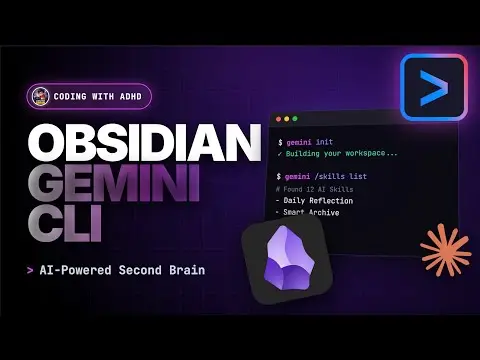
I found this video helpful on how to use Obsidian with the Gemini CLI, but the same steps and logic apply to Claude Code as well. I’ve been using Obsidian with Claude Code, and my vault looks much more organized now.

I’m also experimenting with a new shortcut: I have a note called ‘to claude’ where I dump all sorts of information and instructions throughout the day. I then ask Claude to read that file to process and organize everything. I’ve also created a CLAUDE.md file with vault-specific instructions so I don’t have to keep repeating myself.

This is a pretty basic ‘normie’ setup, and while I keep seeing people on Twitter doing much more advanced stuff, this works perfectly for me. I also asked Claude Code if these skills were useful and it figured out how to use them on its own.

YouTube · youtu.be ↗My Obsidian And Gemini CLI WorkflowCoding With ADHD on YouTube
youtu.be ↗
Note

We are living in wild times

On the magic of conjuring software with plain English, voice-writing blog posts over filter coffee, and why I still can’t wrap my head around these times.

Read the note →
Note

What drives us

Will Manidis hits the nail on its head:

the things that drive humans have been remarkably consistent across time, across technological progress, and across societies.

no matter what kind of millenarianism you are indulging in (ai, ufos, etc)— you can bet the forces of pride, greed, lust, gluttony, etc are constant

Note

The whole is not the sum of its parts

This feels intuitively right to me:

But over the past several years the field of neuroscience seems to have moved away from this modular approach (each brain region has its own job). Researchers are more likely to believe that the brain is a network of interconnected regions. They are more likely to talk about vast and dynamic webs of neurons whose connections link disparate parts of the brain.

Luiz Pessoa, who runs the Maryland Neuroimaging Center, recently offered a metaphor that helps a layman like me understand what’s going on. In an essay for Aeon, he asks us to imagine a flock of starlings swooping and swirling in the sky. No single starling organizes this ballet, yet out of the local interactions between all the starlings a coordinated dance emerges.

As the brain is trying to navigate through the complex situations of the day, it is creating what Pessoa calls “neuronal ensembles distributed across multiple brain regions,” which, like a murmuration of starlings, “forms a single pattern from the collective behavior.”

To read later.

Note

China derangement syndrome

True dat:

The reason could be that when you are powerful, people take note only when that power falters. The world was hardly impressed when Trump went on his tariff rampage; what struck people was when China successfully fought back. America demonstrated stunning military power in Venezuela but it was also expected; what people have noticed is Russia’s military failure in Ukraine.

People also notice who envies whom. And it is no secret that Trump envies China; and that to his chagrin the envy goes unrequited. The US president fantasises about the scope of China’s industrial power, so much that he now practices state capitalism Chinese-style. It is as if Trump has lost trust in his country’s political and economic system. As the saying goes, imitation is the highest form of flattery, and now it is Washington imitating Beijing.

Note

Influentists

100% agree with Carette Antonin. Social media platforms are awash with bullshit claims that are tenuously tied to “some truth” floating free without context accumulating eyeballs and engagement like a snowball turning into an avalanche: This pattern of “hype first and context later” is actually part of a growing trend.…

Read the note →
Note

The future of AI and automation

Charles Jones and Christopher Tonetti on AI and automation: Summary by Claude. Let me break down what Jones and Tonetti are arguing. The Core Question How much of past economic growth came from automation, and what does that tell us about AI’s future impact? The Key Insight: “Weak Links” The paper’s central concept is…

Read the note →
Note

You don’t know much

Latham Turner:

The more deeply I read, the less I have to say.
It’s funny how that works.

I notice that my own thoughts, my own experiences, even my own relationships aren’t as uniquely interesting as I want them to be. I still value the life

I’ve built, but I recognize how much more it could be.
By reading deeply, I realize how much more interesting I could be.

That’s worth passing on.

Note

On AI coding

Leila Clark on the hype around AI coding:

Since Claude can’t create the good abstractions. Claude’s powers are limited by how good the blocks you give it are. Have no illusions; Claude cannot reproduce Sentry and Terraform and Playwright. These are incredibly complex and well-designed pieces of code. And since Claude can’t create good abstractions on its own, there’s a limit to how much anyone can do with Claude alone. Even though everyone on X thinks you can vibe-code all software, I think the opposite is true: the value of good abstractions and well-designed infrastructure has never been higher.

If I had to boil down my criticism of Claude to one sentence, it’s this: Claude doesn’t have a soul. It doesn’t want anything. It certainly doesn’t yearn to create beautiful things. So it doesn’t produce good solutions. It doesn’t write elegant abstractions where there were none; it doesn’t manicure the code garden.

Note

Small tyrannies

A couple of days ago, this phrase popped into my head: “small tyrannies.” I was trying to name this idea, the tyranny of small things. I can’t remember where I first came across it. I vaguely recall reading something along these lines in a Substack post. But anyway, it came up in a conversation with a friend. We were…

Read the note →