Bhuvan.Essays, notes and small websites
Topics · 16

Economics. 16 notes.

Notes16

Note

Thank you, Perry

I woke up to the news that the great Perry Mehrling has passed away. He was 67. I was shocked. It feels unfair that all the cool and awesome people keep getting taken away while assholes still roam free on Earth. Perry was brilliant. A lot of what I understand about global macro, the dollar and the global financial…

Read the note →
ineteconomics.org ↗
Link

A tale of two Chinas

Nice note from BlackRock: Outside China, the key question is whether companies use Chinese technology or compete against it. Cheaper Chinese industrial robots and machinery can boost productivity and ease labor shortages for their customers. For rival producers, the economics are less appealing. European machinery…

Read the note →
BlackRock · blackrock.com ↗Weekly market commentaryStay tuned for insights on hot topics and latest trends in the financial market via the Weekly commentary by the BlackRock Investment Institute.
blackrock.com ↗
Link

Indian government sucks at industrial policy

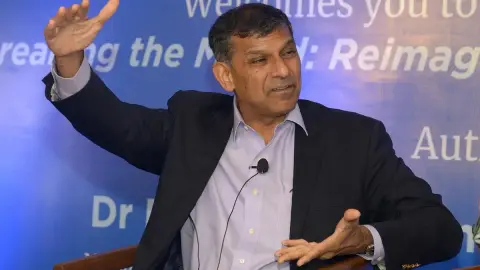
Raghuram Rajan on industrial policy:

I’d say that I am not against the government’s actions; I am very much for the government’s actions on dealing with the fundamentals. So let’s focus on public goods such as education and healthcare, let’s focus on building good roads, let’s focus on creating a good business environment, let’s focus on utilities, let’s focus on water, electricity, logistics. These are areas where you have a much better chance of success improving things rather than [picking winners and sectors].

Whenever our government showers a sector with love, it has not ended particularly well except for the areas I just mentioned. Kudos to the current government for building out Indian infrastructure. That’s great. But I think if you test them on manufacturing, have they really created more manufacturing jobs? The line is flat [on the chart]. Look at the line. I’d say that just the evidence suggests that we have not been great. Maybe some other countries have seen success.

Frontline · frontline.thehindu.com ↗Raghuram Rajan: India’s Jobs Crisis Needs a New Growth ModelRaghuram Rajan argues India needs a services-led growth model to create jobs, while warning against an overreliance on industrial policy.
frontline.thehindu.com ↗
Note

What GDP Doesn’t See

Yet another interesting debate on the limits of GDP, this time triggered by David Deutsch posting about fixing his dishwasher with ChatGPT, and Jesús Fernández-Villaverde riffing on what that means for GDP, welfare and taxation. Amen to this: This is one of those debates that keeps coming back in economics because…

Read the note →
David Deutsch @DavidDeutschOxf · September 12, 2026 ↗I just fixed my dishwasher with the help of ChatGPT. A trivial task. I had been about to order a new one. So this software has increased the country's real wealth yet decreased the measured GDP. The main economic indicator is structurally incapable of registering the thing that…
x.com ↗
Link

Research on the wealth effect

This is quite interesting:

Now, you might think that broader participation in the stock market would increase the strength of the wealth effect, with more households exposed to market volatility. But this is not quite right. ++New research++ from the Federal Reserve Bank of New York finds that the more widely Americans hold shares, the weaker the effect of a rate change on the real economy, which is the opposite of what you might expect: instinctively, the more people who own stocks, the harder a market swing should hit spending.

In fact, what matters, according to Juan Morelli, a New York Fed researcher, is not how many people own stocks but how concentrated the ownership is. When only a sliver of households own stocks, equity exposure is concentrated among relatively few households. So if a rate rise hits share prices, the resulting wealth shock is larger for each participating household, prompting a bigger reduction in spending.

ft.com ↗
Link

How does the preference for sons impact the mental well-being of women in rural India?

Here’s an interesting study regarding Indian women’s preference for sons and its impact on mental health: The researchers surveyed a sample of married women of reproductive age and their co-residing mother-in-law in Jaunpur district, Uttar Pradesh. When there was more than one daughter-in-law in the household, they…

Read the note →
aces.illinois.edu ↗How preference for sons affects women’s mental health in rural India | College of Agricultural, Consumer & Environmental Sciences | IllinoisIn rural India, having a son is a strong social expectation that puts pressure on women to bear male children. A new study from the University of Illinois Urbana-Champaign examines how a firstborn son affects the…
aces.illinois.edu ↗
Note

Is microfinance useful or useless?

In the 1990s, one of the dominant ideas in development economics was that poor people remained poor because they lacked access to credit. If only they could borrow, the argument went, they would invest in productive opportunities, grow their incomes, and escape poverty. That belief sparked the global enthusiasm around…

Read the note →
Note

Economic liberalisation is good for the environment

Economic liberalisation reduces emissions and deaths from pollution:

There is a large literature showing that liberalizations boost economic growth. Do these gains come with environmental costs? In this paper, we use 49 cases of large-scale liberalization – as proxied by large discrete jumps on the Economic Freedom of the World Index – to study the effects of liberalizations on greenhouse gas emissions (total, per capita and per dollar of GDP) and deaths from outdoor air pollution. Using matching methods between liberalizers and non-liberalizers, we find that liberalizations have no consistent effect on total emissions or emissions per capita. However, they do reduce emissions per dollar of GDP and reduce mortality from outdoor air pollution. We then employ synthetic control methods on the largest three liberalizers and the largest de-liberalizer and find the same pattern of results.

sciencedirect.com ↗
Link

Why Is Fertility So Low in High-Income Countries?

Saving this paper to read later: We tentatively conclude that the decline in fertility across recent cohorts in high-income countries is likely the result of evolving norms, expanding choices, and the role of broad social and economic influences. This multi-faceted cohort-based explanation contrasts with narrower…

Read the note →
nber.org ↗
Note

An unified theory of vibes

Kyla Scanlon is one of the most perceptive writers about the US economy and culture. Several years ago, she coined the term “vibecession” to describe the divergence between economic data and how people felt. In other words, after the pandemic, something weird started happening in the US. While economic data, despite the inflationary spike, was getting better, consumer sentiment was getting worse and worse.

Many people have proposed different theories as to why there’s a vibecession, and I’m utterly fascinated with the concept. For all its flaws, it’s a useful frame to think about many of the issues and trends that are shaping our lives. Anyways, here are a few recent posts on vibes.

Everyone is Gambling and No One is Happy.

Vibecession: Much More Than You Wanted To Know.

Theories of vibes.

I’ve been thinking about how much vibes can explain issues and sentiments in developing countries like India.

Note

Naked without values

I read this thought-provoking essay by Kaushik Basu, and I haven’t been able to stop thinking about it. It puts its finger on many of the causes that have led to our age of degeneration—an era where things aren’t imploding but slowly decaying, thanks to our collective ignorance, apathy, and, perhaps most importantly, a…

Read the note →
Note

Will the poor countries catch up the rich?

Came across this fascinating paper looking at whether developing countries are catching up to advanced countries. It’s frankly depressing, but I asked Claude for a summary. ### What Remains of Cross-Country Convergence? A Critical Review of 50 Years of Economic Growth Research. Summary by Claude. This comprehensive…

Read the note →