Bhuvan.Essays, notes and small websites
Notes · 287Page 6 of 10

Short things, kept in the open. A commonplace book, formerly rabbitholes.garden.

Links worth your time with a line on why, quotes, verse, half-thoughts and the occasional rant. Longer pieces live in writing. Follow along by RSS.

Note

Wild times in AI land

I didn’t think I’d live to see a time when a company would “burn” $100 billion. What wild times we’re living in. Wildddd.

OpenAI in particular should beware hubris. One vc says discussion of cash burn is taboo at the firm, even though leaked figures suggest it will incinerate more than $115bn by 2030. Sam Altman, its boss, said recently that one reason he wants to take OpenAI public is to watch its doubters sell it short. “I would love to see them get burned on that,” he said. Plenty of investors seem prepared to take the bet: both the public equity and debt markets have punished companies with significant exposure to his firm. ■
Note

AI and the compression of everything

This reflection was sparked by this tweet from Peter Steinberger, whom you should absolutely follow on Twitter and read on his blog. I came across his account recently and started reading his writing. For an amateur web coder, his blog is surprisingly rich with practical, thoughtful tips. I’ve also been poking around…

Read the note →
Note

On the joys of writing

Wonderful reflection on the rewards of writing by Victor Kumar. The post is filled with other rabbit holes including links to Victor’s writing and also other philosophers writing on Substack. My kinda post 😺

What I didn’t realize was that writing a Substack would also reignite my intellect. Over the first five months, I posted an essay nearly every week. I’ve always read a lot, but before, the words passed through me—my mind a sieve. Now, I keep dozens of running files in my notes app about topics I hope to write about. Before, spare moments were taken up by mindless scrolling. Now, they’re spent writing and editing. Substack brought my mind back to life. I gained autonomy over my work instead of being yoked to journal referees or newspaper editors. My essays here have less professional currency than journal articles, less reach than op-eds, but they’re more meaningful to me. (I’d give it all up for a byline in The New Yorker.)

Note

You can just do things

Amen to this:

François Chollet: Social media is the sedative that makes us forget we ever had freedom and agency. You can just do things, but first you have to close the app.

This entire year has been a case me rediscovering the fact that I can just do things. All you need is orient your inner compass towards fun and then run in that direction.

Amen to this as well:

Kpaxs: Social media consume us, not the other way around.

Note

Reflections on Scott Belsky’s Predictions

Say what you will about the cesspool that Twitter has become. I refuse to call it X. It still remains, for better or worse, a big part of my media diet. Between the outrage and noise, I still find perspectives, articles, videos, and podcasts that make me pause. One such instance was Scott Belsky’s recent set of…

Read the note →
x.com ↗
Note

Building at the speed of thought

Interesting post by Peter Steinberger on coding in the age of LLMs: It’s incredible how far “vibe coding” has come this year. Whereas in May I was amazed that some prompts produced code that worked out of the box, this is now my expectation. I can ship code now at a speed that seems unreal. I burned a lot of tokens…

Read the note →
Note

Skyfall post-AI world edition

I asked Claude to adapt Adele’s Skyfall to a post-AI world: “Digital Fall” \[Verse 1\] This is the end Hold your resume close and pretend That you’ll find work when the models descend When it crumbles We will stand tall Face it all together at digital fall At digital fall \[Verse 2\] I used to draft the briefs at dawn…

Read the note →
Note

Welcome to the slopocalypse

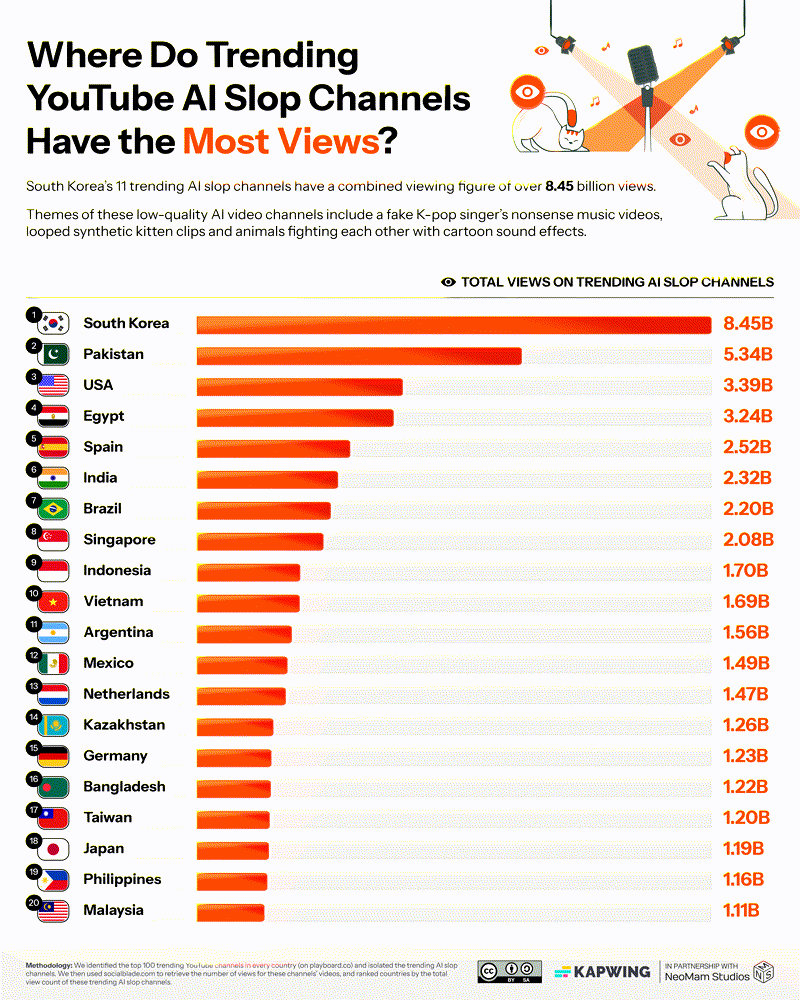
The numbers on AI slop videos are crazy.

Five of the other ten trending AI slop channels with the most views are based in South Korea, with others in Egypt, Brazil and Pakistan. But the channel with the most views of all is in India. Bandar Apna Dost features over 500 videos, mainly “featuring a realistic monkey in hilarious, dramatic, and heart-touching human-style situations,” Many of which are variations on identical set-ups. The channel also has around 100,000 followers on Instagram; on Facebook, the videos are attributed to a ‘digital creator’ named Surajit Karmakar.

Note

Intellectual bacchanalia

There two stunning things in this tweet: I use Claude Code heavily and it’s bloody amazing. That it can help a non-technical person like me to turn my ideal into reality still shatters my mind everyday, even after using Claude Code on an almost daily basis for over a year. It’s magic! I can’t believe it was a side…

Read the note →
Note

Why write

Wonderful reflection on the many joys and rewards kd writing by Drew Breunig. Hard agree with everything, especially this one:

Writing gives you a license to explore and organize your thoughts. This is the fun bit. Chasing down an idea that interests you, forming questions and then investigating them; it’s a joy. The second most common question I get about my writing is, “How do you motivate yourself to write?” This is the answer. There are so many drafts that live, dormant in my draft folder. So many times I start a piece and lose interest. And then: something will click and I’ll draft, investigate, and finish a piece in an hour (here’s two examples). These aren’t always the most substantive pieces, but they keep the practice going and the momentum up.

Came across the article on Twitter.

Note

Summoning Ghosts: Why You Need to Try AI Coding Tools

Note: This is stream of consciousness. I’m working through my thoughts on AI coding tools in real time, and I’m not interested in being measured about it. I woke up this morning and I’m nodding my head so much in agreement that if I keep this up, there’ll be a new medical disorder named after me—the nodding head…

Read the note →
Note

Another lament for literature

Sad but true. It was P.B. Shelley who once framed this faith with prophetic clarity: “Poets are the unacknowledged legislators of the world.” Literature, to him, was a subversive parliament of feeling — moving hearts, unsettling moral certainties, giving form to what was yet to be imagined. Today, that vision lies…

Read the note →
Note

G.K. Chesterton on miracles

Came across this quote here. The believers in miracles accept them (rightly or wrongly) because they have evidence for them. The disbelievers in miracles deny them (rightly or wrongly) because they have a doctrine against them. G.K. Chesterton The full passage: But among these million facts all flowing one way there…

Read the note →
Note

Self improving systems are not possible

Interesting framing by Daniel Jefferies:

Infinitely self recursively improving systems are impossible.

It’s impossible to make a system that can correct all its own mistakes when it is the very thing making the mistake in the first place.

How do I know?

Evolution hasn’t figured it out in millions of years, why would we figure it out in two or two hundred?

Your brain is a bunch of crude hacks. Wonderful hacks and amazing hacks but crude nonetheless.

When you have to figure out if something is “true” or “real” you don’t actually come to any concrete, real, objective truth most of the time.

Instead, we have a ton of micro approximations in our heads that sorta, kinda get closer to an approximation of reality/truth, though sometimes they are way the hell off.

Note

Why AI is not a bubble

I didn’t fully understand the technical details in this analysis but Matt Dratch makes the case that the despite massive AI build up, we’re still massively short on compute:

The core finding: even under generous assumptions about hardware efficiency and utilization, we are likely 8–50x short on compute for consumer inference alone in a mature agentic and multimodal world. This is
before accounting for enterprise, sovereign, robotics, or training demand.
Three claims underpin this framework:

1. Tokens are the kWh of knowledge work. As price falls, users don’t ask the same questions more
cheaply; they ask orders-of-magnitude richer questions involving tools, memory, video, audio, and
sensors.

2. The installed base of frontier AI compute is ~13 GW globally (low 20s by some estimates). The
entire 125 GW of existing data center capacity will eventually convert to accelerated compute, and then
we’ll build beyond that.
3. Cluster-level efficiency is 5–10% of chip specs once you account for MFU, power distribution, and
fleet mix.

Note

A dumb model of AI

I have a dumb model for thinking about AI: keep using it and reason forward. Everything is frankly narrative pollution to me. I find most debates about AI, intelligence, AGI, ASI, and other things largely unhelpful. I’m not saying they are useless; what I am saying is that they are personally unhelpful to me. The best…

Read the note →
Note

AI is overdelivering

AI might be a bubble, but the smart people are using these tools to extract value. My personal take: whether AI is a bubble or not matters to the investors betting on it. The rest of us normies should shut the fuck up and abuse the VC subsidy that’s making these awesome tools accessible for so cheapest. I’m saying this…

Read the note →
Note

Claude Code is awesome, but terribly named

It feels like off late all I am doing here is linking to Simon Willison, but he’s on the money here: Claude Code is, with hindsight, poorly named. It’s not purely a coding tool: it’s a tool for general computer automation. Anything you can achieve by typing commands into a computer is something that can now be…

Read the note →
Note

The debt part of the AI cycle

So U.S. companies issued 1.7 trillion worth of investment-grade bonds, of which Goldman estimates 30%—which is 510 billion—was because of AI boom. Now things are getting interesting. You know, as things start making their way from equity issuance to debt, things become really, really interesting. Because if this AI is…

Read the note →
Note

Some non-advice advice

Post type: Loose reflection. Certainty: Reasonably sure. I get a lot of messages on LinkedIn from young students and graduates. They’ll share a templated note, attach a resume, and ask for a job. When I tell them we’re not hiring, they pivot: “Can you give me some advice then?” And every time, I freeze up. Because I…

Read the note →
Note

Preserving India’s artistic heritage

I read this article in the Scroll, and for the second time, I found myself thinking about how passionate individuals who genuinely care about their culture and history are load-bearing pillars in the broader effort to preserve historical memory. In this case, Priya Paul’s multi-decade effort to collect paintings…

Read the note →
Note

We are a collection of particles but...

We have long been told by physics that we are nothing but a collection of atoms. Perhaps the most memorable line that comes to mind is physicist Brian Greene saying that we are nothing but a collection of particles dancing to the quantum mechanical tunes—or something to that effect.It’s a depressing account of the…

Read the note →
Note

Blogging is good for your soul!

Amen. I couldn’t agree more with Simon Willison: You should start a blog. Having your own little corner of the internet is good for the soul! But what should you write about? It’s easy to get hung up on this. I’ve definitely felt the self-imposed pressure to only write something if it’s new, and unique, and feels like…

Read the note →
Note

The case against superintelligence

I just finished reading this thoughtful post by Tom Dettmers in which he argues that we won’t reach artificial general intelligence or super intelligence. It was a bit technical for me so I asked NotebookLM to simplify it for me: This blog post by Tim Dettmers argues that the popular idea of \\Artificial General…

Read the note →
Note

AGI for normal people is here

Amen. Fullly agree with what Deam Ball is saying. I agree with all this; it is why I also believe that opus 4.5 in claude code is basically AGI. Most people barely noticed, but \it is happening.\ It’s just happening, at first, in a conceptually weird way: Anyone can now, with quite high reliability and reasonable…

Read the note →
Note

Predictive AI > Generative AI

Generative AI is sexy, but predictive AI is useful. To get a sense of the immense progress on predictive AI and its future potential, we can look at the trajectory of the past 20 years. In 2005, we couldn’t get AI to tell the difference between a person and a pencil. By 2013, AI still couldn’t reliably detect a bird in…

Read the note →
Note

The digital world is the only escape

This stuck a nerve. I was lucky enough to have a childhood where I at least spent a few months wandering the wild parts of my parents’ villages for a few months a year. Those experiences have been formative in shaping who I am today.I see kids today and the only play they get is in between dodging incoming vehicles. As…

Read the note →
Note

We are summoning ghosts with LLMs

Brilliant post as usual by Andrej Karpathy: 2025 is where I (and I think the rest of the industry also) first started to internalize the “shape” of LLM intelligence in a more intuitive sense. We’re not “evolving/growing animals”, we are “summoning ghosts”. Everything about the LLM stack is different (neural…

Read the note →
Note

My little heart

What a beautiful article: So much held in a heart in a lifetime. So much held in a heart in a day, an hour, a moment. We are utterly open with no one in the end—not mother and father, not wife or husband, not lover, not child, not friend. We open windows to each but we live alone in the house of the heart. Perhaps we…

Read the note →
Note

Be human

Hmm 🤔

Humans should remain smarter than their refrigerators. It is insane that we are living in a time in which people are trying to make refrigerators smarter, but are satisfied to dumb down themselves and those around them. All the evidence suggests that AI is bad for your brain. If you use it as a salve for social and romantic frustration, it also makes it harder for you to connect with others and less resilient in the face of real life. If you let AI create more distance between you and words and language, you are allowing it to threaten some of the most important distinctions between humans and animals.

AI is sold to us on the premise that it can offer us life on easy mode. No such mode exists. Life is for living, not escaping. Be human. Read human.

AI? Hard pass. Be human. Read human.