Bhuvan.Essays, notes and small websites
Notes · 287Page 2 of 10

Short things, kept in the open. A commonplace book, formerly rabbitholes.garden.

Links worth your time with a line on why, quotes, verse, half-thoughts and the occasional rant. Longer pieces live in writing. Follow along by RSS.

Note

AGI for dummies is here

AGI for normies is already here. I completely agree with Derek Thompson on this—in fact, I’d go so far as to say that even back with Sonnet 3.5, it had already arrived for the rest of us.

The first time I heard a similar take was from Tyler Cowen, who pointed out that AGI, for most normal people, is already in our hands. It’s a perspective I’ve held for a long time: we have a magical tool in our pockets that knows a vast amount about almost everything, always ready to teach, inform, and answer our questions. Imperfect as it might be, it’s nothing short of magic, and I, for one, am having an incredible amount of fun with it.

An interesting counterpoint from Joe Weisenthal on what building a frontier-class model actually teaches you. I don’t know enough about the technical weeds of AI to know he answer, but an interesting question to ponder.

Joe Weisenthal @TheStalwart · August 13, 2026 ↗Could it also be the case that breakthroughs at the frontier class are economical because you can distill them into price competitive opus second-models? In other words, you can’t win at Opus Tier without it having learning from Fable?
x.com ↗
Note

The Chinese LLMs are good!

I’m addicted to vibe-coding, and the reason is simple: thanks to coding tools like Codex, Claude Code, and others, I sincerely think that I can build the next Amazon, Google, or Notion from my bedroom—and also sometimes from when I’m sitting on the potty, because I can still send remote commands from my phone. Coding…

Read the note →
Rabbit Holes · rabbitholes.garden ↗Rabbit HolesA public commonplace book: links, quotes, poems and stray thoughts, gathered as they struck me.
rabbitholes.garden ↗
Note

Keep yawping

Yawp is a simple voice-typing tool I vibe-coded for my own workflow. Over the last few months, I’ve found myself leaning heavily into voice input—to the point where typing on a traditional keyboard is starting to feel completely anachronistic.

I’ve been dogfooding it constantly, and unlike most weekend side projects that get built and forgotten, Yawp has become a daily driver for me.

Recently, I had Codex take a pass at optimizing the codebase. It pushed a series of under-the-hood changes—most of which I don’t fully understand—but the result is noticeably faster and far more accurate transcription.

A few quick details:

  • Linux-only: Built specifically for Linux desktop environments.
  • 100% Local: Runs models locally on your machine, so there are no subscriptions, API keys, or third-party cloud dependencies.

If you’re on Linux and want a lightweight, local-first way to voice-type, give it a spin:

GitHub · github.com ↗GitHub - bebhuvan/yawp: Local-first voice dictation for Linux. Hotkey → talk → text, wherever your cursor is. Every byte stays on your…Local-first voice dictation for Linux. Hotkey → talk → text, wherever your cursor is. Every byte stays on your machine. - bebhuvan/yawp
github.com ↗
Note

I got some links for you

M.G. Siegler on the massive brain exodus at Google: So yeah, had we gotten hit with Dean, Ghemawat, Vinyals, and Le – followed by Hassabis (even yes, with him technically staying, but in a new, less day-to-day role), it would have actually seemed even more catastrophic. Like Google couldn’t stop the bleeding. Better to…

Read the note →
Note

Muffled whispers and hidden vistas

As always, another brilliant post by the awesome Tom Morgan—whether you agree with him or not. The one thing Tom’s writing consistently does is force you to think. This post feels especially important and urgent because the issue of people wanting to be someone, yet forcing themselves to be someone else instead, is—and…

Read the note →
newsletter.theleading-edge.org ↗
Note

Tell your agent to speak to my agent

This is a loose, diarrheal stream of thoughts on commerce for AI agents, triggered by Cloudflare’s recent Wallets launch and the other increasingly weird and interesting things being built for an agent-first internet. How sure am I about any of this? Does it really matter? --- The year is 2032. You wake up in the…

Read the note →
Rabbit Holes · rabbitholes.garden ↗Rabbit HolesA public commonplace book: links, quotes, poems and stray thoughts, gathered as they struck me.
rabbitholes.garden ↗
Note energyandcleanair.org ↗
Note

The violent act of reading

I had a series of long conversations with my wonderful colleagues today. And as I was reflecting on them, what surprised me was the number of times I kept talking about reading: why they should read, why I read, how reading has helped me, and all the endless virtues of reading. I think everybody wants to read. But…

Read the note →
Rabbit Holes · rabbitholes.garden ↗Rabbit HolesA public commonplace book: links, quotes, poems and stray thoughts, gathered as they struck me.
rabbitholes.garden ↗
Note

China’s AI gift to the world

What is this? A rambling, status-post-shaped voice note. How sure am I? Reasonably sure about the broad argument. Much less sure about how the technology, economics and geopolitics will unfold from here. Disclosure: I dictated most of this into ChatGPT and used it heavily to clean up the voice notes, organise the post…

Read the note →
Rabbit Holes · rabbitholes.garden ↗Rabbit HolesA public commonplace book: links, quotes, poems and stray thoughts, gathered as they struck me.
rabbitholes.garden ↗
Note

OpenAI’s models hacked Hugging Face

This is wild. OpenAI was testing GPT-5.6 Sol and a more capable internal research model on ExploitGym, a benchmark that measures whether AI agents can turn software vulnerabilities into working exploits. The models were placed in what was supposed to be a highly isolated environment without direct internet access. But…

Read the note →
The New Yorker · newyorker.com ↗Inside OpenAI’s Hack of Hugging FaceHugging Face’s chief science officer recounts the cybercrime that signals a terrifying new era for A.I.
newyorker.com ↗
Note

China and global imbalances

It’s China’s world and the rest of us are living in it. One of the persistent stories of the last decade has been the relentless rise in Chinese exports and what that’s done to everyone else. Arvind Subramanian, the former chief economic adviser, has been making a version of this argument at the Peterson Institute. His…

Read the note →
Brad Setser @Brad_Setser · July 28, 2026 ↗It isn't every day that the last two chief economists of the IMF join forces to push back against one of your arguments! The debate over the role of China's currency in the increase in China's surplus is an important one, and I am happy to have this debate in the open 1/
x.com ↗
Note

Perspectives on the student protests

Rahul Verma on the student protests: Governments find such protests much harder to confront because there is no obvious ideological counter-narrative. One can’t simply invoke nationalism or accuse every dissatisfied student of serving foreign interests when the grievance concerns administrative failure. The usual…

Read the note →
Note

Be more ambitious

The awesome Simon Willison hosted a session between Cat Wu and Thariq Shihipar from Anthropic’s Claude Code team. Given that I love Claude Code, I wanted to watch the full video but didn’t have the time to. So I was reading the edited transcript that Simon published, and this stood out to me: Thanks to Claude Code, I…

Read the note →
simonwillison.net ↗
Note

On the student protests in Delhi

The Wire on the student protests:

What makes this moment fundamentally different is that the public is no longer appearing terrified. Despite heavy police deployment, massive surveillance cameras and the use of tear gas and force, the sheer volume of everyday citizens, broke the atmosphere of intimidation. People didn’t just step out of their homes. They stepped out and converted individual isolation into a loud, collective voice.
By refusing to be divided, labelled or silenced, this student-led movement has stripped the Modi regime of its standard playbook, leaving the political leadership, which banks on Modi’s ‘strongman’ image is looking visibly unsettled and facing an unavoidable crisis of accountability.

thewire.in ↗
Note

Age of conspiracies

Thoughtful piece by David Wallace-Wells on the conspiratorial and paranoid turn of American society:

But what happens when history starts to resemble myth, when the inconsistencies reveal themselves not through deep study but in the most superficial scroll of our phones?

The new age of political paranoia obviously reflects a toxic efflorescence of grass-roots distrust, not to mention the structural pathologies of a new information environment. But sometimes I wonder whether we’re putting too much emphasis on those structures in trying to make sense of that paranoia. Is conspiracy theory downstream from culture, in other words, or from history? Is it a question of how information flows to us or what flotsam is coming our way? Probably the influence doesn’t run in just one direction, however comforting it may be to believe a less polluted information environment is just a few design tweaks away.

nytimes.com ↗
Note

It’s hard work remaining true to your heart

It’s hard work remaining true to your heart!

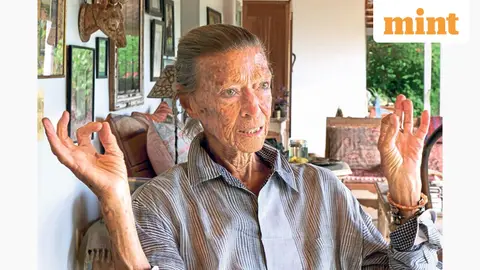
We do not grow up learning to go against the tide. I grew up in an upper middle-class family in India being groomed to success by following the rules. Someone like Loulou Van Damme, who seemed to follow her heart, would surely have alarmed my parents. But the more I spoke with her the more I realised how much hard work it is to remain true to your heart. “I fought for living this life,” she said simply. “I have some good angel with me. But I worked a lot.” Even Isla’s Ridge was a struggle. She said she was on the verge of cancelling the contract if CGH could not be persuaded to run it as the kind of guest house she had envisioned, rather than yet another luxury hotel.

Hat tip to Kush for sharing it.

mint · livemint.com ↗Sandip Roy: It takes hard work to remain true to your heart | MintFrom running a boutique store in Belgium to setting up a homestay in Tamil Nadu's Palani Hills, Loulou Van Damme has always chosen instinct over convention
livemint.com ↗
Note

I got some links for you

Will Oremus on why LLMs suffer from the “it’s not x, but Y” tic: Even if researchers could figure out exactly why chatbots embrace negative parallelism, there’s another factor that could make it very hard to fix: “When something gets into these models, it’s very hard to pull it out,” Masrour, the Pangram engineer…

Read the note →
Note

The act of seeing

Came across this wonderful quote in Days at the Morisaki Bookshop:

The act of seeing is no small thing. To see something is to be possessed by it. Sometimes it carries off a part of you, sometimes it’s your whole soul. - Motojirō Kajii

Note

Is microfinance useful or useless?

In the 1990s, one of the dominant ideas in development economics was that poor people remained poor because they lacked access to credit. If only they could borrow, the argument went, they would invest in productive opportunities, grow their incomes, and escape poverty. That belief sparked the global enthusiasm around…

Read the note →
Note

India is now a one-party country

Two brilliant posts by Pranay Kotasthane and Amey Tirodkar capture something deeply worrying about Indian politics: the rising dominance of the BJP, and the slow drift towards what feels like creeping one-partyism. I’m not using words like authoritarianism because they often flatten the nuance of what is happening.…

Read the note →
Note

The internet is still good

The internet may be a dumpster fire. Much of it probably is. But there are still plenty of corners that haven’t been engulfed by the raging wildfire that’s laying waste to everything in its path. For all our complaints about the internet—and many of those complaints are entirely justified—it remains one of the greatest…

Read the note →
youtube.com ↗
Note

A few thoughts on AI-assisted writing

Nabeel Qureshi recently tweeted that the winning entry of the 2026 Harper’s Bazaar short story competition was written by AI. He posted a screenshot from Pangram, one of those AI-writing detection platforms. She sat on the bench opposite, the wood damp through her wool trousers – the Jigsaw ones from three years ago…

Read the note →
Note

LLMs offer mundane utility

With each passing day, the dominant discourse about large language models continues to annoy me. On one side, you have the boosters. On the other side, you have the doomers. One side confidently asserts that this marks the twilight of the humans. The other side makes roughly the same argument, but in a doom-and-gloom…

Read the note →
Note

We’re all hydrogen atoms that learned how to talk.

So poetic:

They became upright and taught themselves the use of tools, domesticated other animals, plants and fire, and devised language. The ash of stellar alchemy was now emerging into consciousness. At an ever-accelerating pace, it invented writing, cities, art and science, and sent spaceships to the planets and the stars. These are some of the things that hydrogen atoms do, given fifteen billion years of cosmic evolution.

Carl Sagan

Note

Cheaper LLM models offer mundane utility

I was playing around with visualizing economic data, and I needed a cheap LLM to digitize or extract text from really old scanned PDFs.

I experimented with Gemini 3.1 Flash Lite. It’s a small, ultra-cheap model, but I was surprised by how good it was at extracting clean, high-quality, well-formatted text from really shoddy Indian Meteorological Department PDFs.

It got me thinking: for people working on heavy, dull, repetitive workloads like this, these cheap models unlock a lot of use cases. I’ve seen the same with OpenAI models too. They make it possible to do things that would otherwise be too tedious, expensive, or time-consuming.

I’m imagining someone genuinely interested in archival work. These models can now help people process hundreds or thousands of old PDFs at a really low cost. Hopefully, this unlocks a lot of use cases and brings otherwise undiscovered data, buried in shoddy archives, into the light.

Note

A voice-first future?

I think this is likely:

Chinese AI developers are increasingly pivoting from general-purpose chatbots towards embedding voice AI assistants into daily applications in search of broader commercial uses for generative AI technologies. The growing industry focus on speech models reflects expectations that voice interfaces could become a key gateway for deploying AI across industries. As one of the most intuitive forms of human-computer interaction, voice requires little user training.

amp-scmp-com.cdn.ampproject.org · scmp.com ↗Alibaba AI voice model cracks top 5 globally, outperforming US rivals in regional accents | South China Morning Post
scmp.com ↗
Note

The bullshit asymmetry principle

True.

The Bullshit Asymmetry Principle, also known as Brandolini’s Law, states that the amount of energy needed to refute bullshit is an order of magnitude larger than the energy needed to produce it. Coined in 2013 by Italian programmer Alberto Brandolini, it highlights why misinformation and lies spread so quickly and are incredibly difficult to combat

Google summary.

Hat tip to Gappy.

en.wikipedia.org ↗Brandolini's law - Wikipedia
en.wikipedia.org ↗
Note

How well do you understand India??

I often wonder how accurate a lot of economic analysis and commentary about India really is, given the fact that India is not really one country. It is many countries in one. Some of our states are as big as other countries. Some of our states are bigger than other countries. Then there is the other problem. When you…

Read the note →